

MAGGID, The Story of the Exodus
Leader
Questioning is a sign of freedom, proof that we are free to investigate,
to analyze, to satisfy our intellectual curiosity. The Talmud states
that anyone can ask questions; the youngest, the oldest, even a scholar
at the table of scholars. Because we encourage our children to question
and to join in our observance, now let one of them ask the Four Questions,
about the differences that mark this night.
Mah Nishtanah, the Four Questions
A child or any inquisitive person
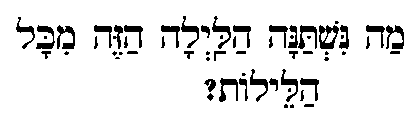
- Mah nishtanah ha-lailah ha-zeh mi-kol ha-laylot?
- Why is this night different from all the other nights?
- On all other nights, we eat either leavened bread
or matzah;
why, on this night--only matzah?
- On all other nights, we eat all kinds of herbs;
why,
on this night, do we especially eat bitter herbs?
- On all other nights, we do not dip herbs at all;
why,
on this night, do we dip them twice?
- On all other nights, we eat in an ordinary manner;
why, tonight, do we dine with special ceremony?
Arba Banim, the Four Children
Leader
Four times the Torah bids us tell our children about the Exodus from
Egypt. Four times the Torah repeats: "And you shall tell your
child on that day..." From this our tradition infers that there
are four kinds of children. To each we respond in a different manner,
according to the question, the situation, and the need.
Participant
The wise child questions, "What are the precepts, laws, and observances
which Adonai our God commanded us?" In response to this child we explain
the observances of the Passover thoroughly, the very last one of which
is: After the Passover Seder, we do not turn to other kinds of entertainment.
We talk with this child about the nature of freedom and justice and
about the need to act to transform the world.
Group
It is the wise who want to know the service it is theirs to do.
Participant
The scornful child questions, "What does this Seder mean to
you?" Notice that this child says to you as would
a person who does not feel personally a part of the Jewish people.
By being distant from us this child denies redemption by rejecting the
essential tenet of our faith: the unity of Adonai our God and the
community of Israel. To this child we say: Join us tonight.
Be fully here. Listen closely. Be with us, become part of us. Then
you will know what the Seder means to us.
Group
It is the scornful who withdraw the self from anything beyond the
self; and so, from the joy of redemption.
Participant
When the simple child questions, "Mah zot, what is this?"
then we say, "We are remembering a time long ago in another land
when we were forced to work for other people as slaves. With a mighty
arm Adonai our God made us a free people and we are celebrating our
freedom." Growing older, learning more about our people, and observing
the seder year by year, this child too will come to love Pesach and
to appreciate its beauty and its message.
Group
To those of open simplicity, give a straightforward answer; for "The
Torah of God makes wise the simple."
Participant
And with the child who doesn't think to question, we must take the
initiative. With patience and tenderness we say: This wonderous evening
happens in the spring of every year, so we may remember how out of
death and sorrow and slavery come life and joy and freedom. To remember
the sorrow we eat bitter herbs; to remember the joy we drink sweet
wine.
Group
With one who has not started to inquire, you must begin to awaken
the mind.
Participant
As in the pages of our histories, so too in the events of our time,
in the encounters of our daily lives, these figures, the wise, the
scornful, the simple, the innocent, reappear in various guises. To
this day, their questions must be pondered and answers sought anew,
the story given life and meaning.
Avadim hayinu, "We were slaves to Pharaoh..."
Leader
The Haggadah sets forth two essential themes:
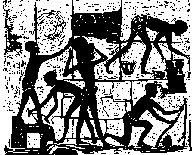
1. Avadim hayinu l'Pharaoh b'Mitzrayim. We, not just our ancestors,
were slaves to Pharaoh in Mitzrayim, but Adonai our God brought
us out from there with a mighty hand and an outstretched arm. If the
Holy One had not redeemed us, we and our descendants would still be
Pharaoh's slaves.
2. Even if all of us were wise, all of us people of understanding,
all of us learned in Torah, it is still incumbent upon us to tell
the story of the Exodus. The more we search deeply into its meaning
and the more we expand upon its message of freedom, the more praiseworthy
are we.
Participant
As an example of how important is the search for meaning even in the midst
of great adversity, the story is told that long ago, during the first century, five
great scholars sat around the Seder table at B'nai Berak one Passover eve
and read the words of the Haggadah, deliberating over their meaning.
The Romans had destroyed the Temple; the people were plotting their
struggle for freedom. And although it was in violation of Roman decree
to study or teach, there they sat--these great scholars--unmindful
of the hours that were flying by. The meeting broke up only when one
of their students came and said to them, "Our teachers, the time
has already come to recite the Sh'ma of the morning service."
Group
Our Redemption is not yet complete.
Participant
The struggle for freedom, for the elusive rights of life, liberty
and the pursuit of justice, is a constant one. In every age, some
new freedom is won and established, adding to the advancement of human
happiness and security. Yet each age creates more Pharaohs and more
enslavements, requiring new liberations. The victory over the first
Pharaoh in Egypt was but the beginning, a foreshadowing of all the
emancipations that were to follow, and which will yet follow in the
days to come. Mitzrayim means the narrow place--the place
that squeezes the life out of a human soul and body. We are all still
enslaved in Mitzrayim, because we are all still struggling
to be free. We are duty bound to retell and expand upon the story
of our Exodus from Mitzrayim to remind us to work for the time when
all the Pharaohs of the world will be vanquished, when right will
conquer might, when God alone will rule, and all peoples will enjoy
peace and freedom.
Mi-techilah ovdei, beginning with degradation
Group
Without remembrance there is no redemption.
Participant
In the beginning our ancestors worshipped idols, but then Adonai
our God called us to holy service. In the city of Ur, our patriarch
Abraham was the first to understand that God is One, the Eternal.
Abraham rebelled against the senseless practice of bowing down to
the work of one's own hands. To worship God in freedom, Abraham had
to flee the land of idolators and go to the land of Canaan, where
he would become the founder of "a great nation." Abraham and
his wife, Sarah, obeyed God's command and journeyed to Canaan. There
God blessed them and their family. Their son was Isaac, who married
Rebecca. Their grandson was Jacob; and it was Jacob and his family
who went down to Egypt.
Leader
Yisra-el means literally "one who struggles with God."
One night after Jacob had wrestled with a mysterious stranger until daybreak,
he had another name given to him, the name Yisra-el -- "Israel." His descendents
were called "the children of Israel."
Baruch shomeir
Participant
We praise the Eternal who keeps faith with the children of Israel.
Adonai's promise of Redemption in ancient days sustains us now. As
we read in the Torah: "Know this for certain, that your descendents
will be strangers in a strange land, and be enslaved and oppressed
for four hundred years. But know with equal certainty that in the
end I shall bring judgment on the oppressors, and your offspring will
go forth with great prosperity."
(All raise their cups of wine.)
It is this promise which has sustained our ancestors and sustains
us. For neither once, nor twice, nor three times was our destruction
planned; in every generation they rise against us to destroy us, and
in every generation a Divine Power delivers us from their hands into
freedom.
(All replace their cups untasted.)
Arami oveid avi, "My father was a wandering Aramean"
Leader
- The sacred history of our people does not start with the tales of
great heroes, nor of the righteous founding fathers, but with humble
beginnings.
- Our story begins with degradation and rises to dignity.
- Our story moves from slavery toward freedom.
- Our story opens with idolatry and advances toward
the unity of God.
We began not with a heroic chapter but a bleak one. Not only have
we known the degradation of physical bondage and spiritual servitude,
but we have also been subjected to social degradation. For in the
eyes of others we were nothing but a subject people -- Arameans.
Group
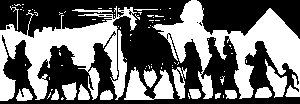
My father was a wandering Aramean. He went down to Egypt with a small
family and sojourned there, and there became a great and populous
nation.
Participant
Isaac's son Jacob had many sons, but his favorite was Joseph, who
was sold by his jealous brothers to a caravan, and they brought Joseph
to Egypt. Joseph rose to become the Pharaoh's minister over all Egypt.
He prepared storehouses with grain in anticipation of the great
famine. When the drought and famine fell on all the region, Joseph's
brothers came to Egypt to buy food. He recognized them, and had them
bring Jacob and Leah and all their families to Egypt. There the Israelites
lived and prospered and multiplied.
Participant
After Joseph died and all his brothers and all that generation...a
new king arose over Egypt who did not remember Joseph. And he said to
his people, "Look, the Israelite people are flourishing and getting
really strong. Let us, then, deal shrewdly with them, lest they become
more powerful, and in the event of war, join our enemies in fighting
against us and gain control over the region."
Participant
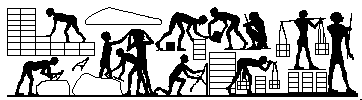
So they set taskmasters over them with forced labor and made them build
garrison cities for Pharaoh; Pithom and Raamses. The Egyptians embittered
their lives with harsh labor at mortar and brick and in all sorts
of work in the fields. But the more they were oppressed, the more
they increased and spread out, so that the Egyptians came to despise
and dread the Israelites. Pharaoh charged all his people, saying,
"Every boy that is born shall be thrown in the Nile, but let every
girl live." We cried out to Adonai, the God of our ancestors,
and Adonai heeded our plight, our misery, and our oppression.
Participant
Adonai heard our moaning. and remembered the covenant that was made
with Abraham and Sarah, with Isaac and Rebekah, with Jacob, Leah and
Rachel, with Bilhah and Zilpah and with every member of the House
of Israel, even the generations waiting to be born. And Adonai said,
"I will go through the land of Egypt...and I will mete
out justice against all the gods of Egypt." Adonai called to Moses,
charging him to appear before Pharaoh and demand that the people be
released. But Pharaoh was stubborn; he would not heed the word of
God. Nine times Moses went to Pharaoh to convince him of the supreme
power of the Almighty. Nine times Pharaoh denied the Almighty
and placed his trust in his own powers and his own gods. In the face
of all pleas and portents, he refused to free the Israelites.
Participant
Many perished and the suffering was great. Pharaoh, nonetheless, remained
obstinate; he would not yield. Finally when Adonai visited the tenth
plague upon them, the death of first-born sons of Egyptians, a great
cry went up throughout Egypt, and Pharaoh ordered Moses to take his
people out of the land. And so Adonai brought us out of Egypt by a
mighty hand, by an outstretched arm and awesome power, and by signs
and portents; not through a messenger, not through any intermediary
or any supernatural being, but the Holy One, alone, in solitary glory.
Makot Mitzrayim, the Plagues of Egypt
Group
Our rabbis taught: When the Egyptian armies were drowning in the sea,
the Heavenly Hosts broke out in songs of jubilation. God silenced
them and said, "My creatures are perishing, and you sing praises?"
Leader
Though we descend from those redeemed from brutal Egypt, and have
ourselves rejoiced to see oppressors overcome, yet our triumph is
diminished by the slaughter of the foe.
Group
Our rabbis taught: "The sword comes into the world because of
justice delayed and justice denied."
Leader
To remember upheaval that follows oppression, we pour ten drops for
the plagues upon Egypt.
Group
Our rabbis taught: God is urgent about justice, for upon justice the
world depends...
Leader
A full cup is the symbol of complete joy. Though we celebrate the
triumph of our sacred cause, our happiness cannot be complete so long
as others had to be sacrificed for its sake. We shall, therefore,
diminish the wine in our cups as we recall the plagues visited upon
the Egyptians, to give expression to our sorrow over the losses which
each plague exacted. We now recite the list of the ten ancient plagues,
pouring off wine as each one is mentioned.
(Lessen your cup of wine with each of the following.)
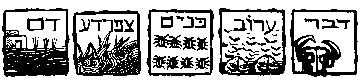
Group
Dam, Blood
Tzfardeyah, Frogs
Kinim, Lice
Arov, Swarms
Dever, Blight
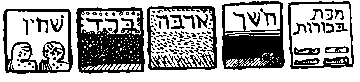
Sh'chin, Boils
Barad, Hail
Arbeh, Locusts
Choshech, Darkness
Makat B'chorot, Death of the First-Born.
Leader
Each additional drop of wine we now pour out of our cups is hope and
prayer that people will cast out the plagues that today threaten everyone
everywhere they are found, beginning in our own hearts:
Group
Apathy in the face of evil,
Brutal torture of the helpless,
Cruel mockery of the weak,
Despair of human goodness,
Envy of the fortune of others,
Falsehood corroding our faith,
Greedy theft of earth's resources,
Hatred of learning and culture,
Instigation of war and aggression,
Justice delayed, justice denied, justice mocked...
Dayenu, it would have been enough
Leader and Group alternate
How many are the gifts Adonai our God has bestowed upon us!
Had Adonai:
- Brought us out of Egypt and not divided the sea for
us,
- Dayenu
- Divided the sea and not permitted us to cross on dry
land,
- Dayenu
- Permitted us to cross on dry land and not sustained
us for forty years in the desert,
- Dayenu
- Sustained us for forty years in the desert and not
fed us with manna,
- Dayenu
- Fed us with manna and not given us the Sabbath,
- Dayenu
- Given us the Sabbath and not brought us to Mount Sinai,
- Dayenu
- Brought us to Mount Sinai and not given us the Torah,
- Dayenu
- Given us the Torah and not led us into the land of
Israel,
- Dayenu
- Led us into the land of Israel and not built for us
the Temple,
- Dayenu
- Built for us the Temple and not sent us prophets of
truth,
- Dayenu
- Sent us prophets of truth and not made us a holy people,
- Dayenu
- For all these--alone and together--we say
- Dayenu
Participant
What does this mean, "Dayenu--it would have been enough"?
Surely no one of these would indeed have been enough for us. Dayenu means
to celebrate each step toward freedom as if it were enough,
then to start out on the next step. Dayenu means that if we reject each
step because it is not the whole liberation, we will never be able
to achieve the whole liberation. Dayenu means to sing each verse as if
it were the whole song--and then sing the next verse!
All sing
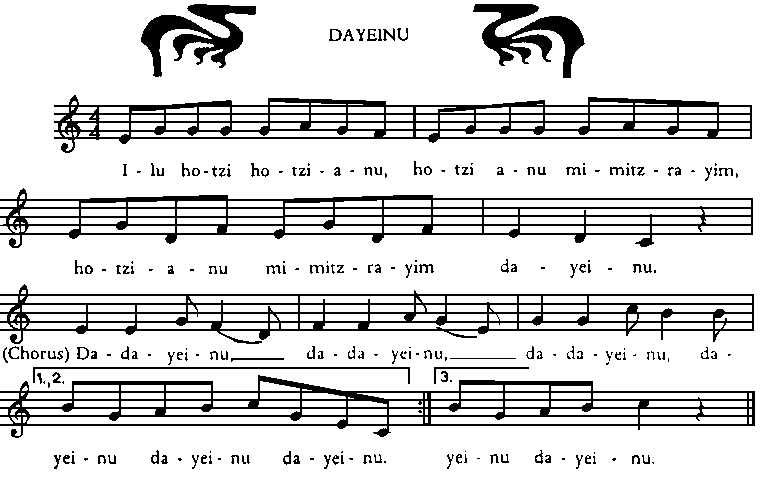 Day, Dayenu, day, dayenu, day, dayenu, dayenu, dayenu
dayenu...
Day, Dayenu, day, dayenu, day, dayenu, dayenu, dayenu
dayenu...
Ilu hotsi hotsianu, hotsianu mi-Mitzrayim, hotisanu mi-Mitzrayim, Dayenu.
Ilu natan natan lanu, natan lanu et ha-Shabot, natan lanu et ha-Shabot,
Dayenu.
Ilu natan natan lanu, natan lanu et ha-Torah, natan lanu et ha-Torah,
Dayenu.
Pesach, matzah, maror
Leader
The Passover Seder is rich in symbolism, but there are three symbols
that are so important and so meaningful that, in the words of Rabbi
Gamaliel, grandson of Hillel, no Seder is really complete unless they
are fully explained. These symbols are the pesach, the matzah,
and the maror.
What is the meaning of this pesach?
Participant
 This bone is the symbol of the pesach lamb. After many
years of wandering in the desert, the Israelites came to dwell in
their own land, where each year, they would gather together at the
Temple to celebrate the Exodus with rejoicing and festivity. Families
would come from all parts of the land for the occasion, and each family
would bring a lamb as its special offering in honor of the festival.
This lamb was known as the pesach, in remembrance of the time
when our ancestors were spared the tragic fate of the Egyptians, whose
first-born were slain. For them, the pesach was a reminder
that God posach -- "passed over" -- the houses
of our ancestors in Egypt during the redemption.
This bone is the symbol of the pesach lamb. After many
years of wandering in the desert, the Israelites came to dwell in
their own land, where each year, they would gather together at the
Temple to celebrate the Exodus with rejoicing and festivity. Families
would come from all parts of the land for the occasion, and each family
would bring a lamb as its special offering in honor of the festival.
This lamb was known as the pesach, in remembrance of the time
when our ancestors were spared the tragic fate of the Egyptians, whose
first-born were slain. For them, the pesach was a reminder
that God posach -- "passed over" -- the houses
of our ancestors in Egypt during the redemption.
Group
Today, too, we invoke Adonai as the guardian of the people of Israel,
as in our dwellings we renew the family bond and strengthen our ties
with the whole people of Israel.
Leader
What is the meaning of this matzah?
Participant
 There are three matzot, and so the meaning of the matzah
is threefold. At the very beginning of the Seder, we learned that
the matzah is, first of all, a symbol of the simple bread of
poverty our ancestors were made to eat in their affliction, when they
were slaves in the land of Egypt.
The matzah also reminds us of the great haste in which the
Israelites fled from Egypt. So hard did the Egyptians press them that,
as we read in the Torah: "They baked unleavened cakes of the dough
since they had been driven out of Egypt and could not delay, nor had
they prepared provisions for themselves."
There are three matzot, and so the meaning of the matzah
is threefold. At the very beginning of the Seder, we learned that
the matzah is, first of all, a symbol of the simple bread of
poverty our ancestors were made to eat in their affliction, when they
were slaves in the land of Egypt.
The matzah also reminds us of the great haste in which the
Israelites fled from Egypt. So hard did the Egyptians press them that,
as we read in the Torah: "They baked unleavened cakes of the dough
since they had been driven out of Egypt and could not delay, nor had
they prepared provisions for themselves."
Participant
There is a third meaning to the matzah. In ancient times, the
Israelites lived in the desert. Like all desert peoples, they lived
simply. They dwelt in tents, dressed in plain garments, and ate only
the simplest of foods. Even their bread was only an unleavened cake,
like the matzah we eat tonight. When the Israelites settled
in Canaan, they became farmers. Soon they prospered; and they began
to desire fancy homes to live in, fine clothes to wear, and rich foods
to eat. This made them greedy and envious. The Prophets cried out
against their way of life and pleaded with them to return to the simple
and modest ways of the desert.
Participant
So, for one week each year the matzah became the symbol of
those early days when all people had little, but none had more--when
equality prevailed among the Israelites. Let the matzah be
a symbol for us this week. Let it teach us to find delight not in
selfish luxuries that excite the envy of our neighbors, but in simple
acts of helpfulness and kindliness that inspire their respect and
love. Luxuries when shared by all are good to have; they add to our
enjoyment of life and help to make us happy. But when the few have
more than they need, and the many have not even life's necessities,
then the plea of the Prophets must be heard. Let us strive to bring
about peace with equality and justice for everyone. To the driven
of the earth we link ourselves today as we fulfill the mitzvah:
Group
"For seven days shall you eat matzah, that you may remember
your departure from Egypt as long as you live."
Leader
What is the meaning of this maror?
Participant
 We eat the maror, or bitter herbs, to remind ourselves that
the Egyptians embittered the lives of our people. As it is written:
"And they made their lives bitter with hard labor at mortar and
brick and in all sorts of drudgery in the field; and they ruthlessly
imposed all the tasks upon them."
We eat the maror, or bitter herbs, to remind ourselves that
the Egyptians embittered the lives of our people. As it is written:
"And they made their lives bitter with hard labor at mortar and
brick and in all sorts of drudgery in the field; and they ruthlessly
imposed all the tasks upon them."
Group
Today, as well, wherever oppression remains, Jews taste its bitterness.
Leader
Pesach, matzah, and maror are the symbolic expressions
that represent freedom in all ages. Translated into modern terms,
they are sacrifice, preparedness, and remembrance. These are major
elements in the battle for freedom.
B'chol dor ve-dor, in every generation
Participant
In every generation, each of us should feel as though we ourselves
had personally gone forth from Egypt. Every generation must discover
freedom anew. For we read in the Torah: "And you shall explain
to your child on that day, it is because of what the Eternal did for
me when I went forth from Egypt." Every generation must earn its
claim to liberty. It is an ever recurring theme of history. We continue
to remember: "It was we who were slaves...we who were strangers."
And therefore, we recall these words as well:
Group
You shall not oppress a stranger, for you know the feelings of the
stranger, having yourselves been strangers in Egypt.
Participant
When strangers reside with you in your land, you shall not wrong
them... You shall love them as yourself, for you were strangers
in Egypt. You shall rejoice before God with your son and
daughter...and the stranger, and the orphan, and the widow in your
midst. Always remember that you were slaves in Egypt. You
shall not subvert the rights of the stranger or the orphan. Remember
that you were a slave in Egypt. Not only our ancestors alone
did the Holy One redeem but us as well, along with them, as it
is written:
Group
"And God freed us from Egypt so as to take us and give us the
land promised to our ancestors."
Le-fi-chach, let us rejoice
(The wine cups are raised.)
Participant
Therefore, let us revere, exalt, extol, acclaim, adore
and glorify the Holy One who performed these miracles for our ancestors
and for us.
- Let us rejoice at the wonder of our deliverance:
- from bondage to freedom,
- from agony to joy,
- from mourning to festivity,
- from darkness to light,
- from servitude to redemption.
Halleluyah. Praise the name of Adonai.
Sing praises, you servants of Adonai.
(The wine cups are set down without drinking.)
Hallel, psalm 114
Participant
When Israel went forth from Mitzrayim,
When Jacob's house left the alien nation,
Then Judah became God's holy place,
Israel God's dominion...
Tremble, O earth,
At the presence of the God of Jacob,
Who turns the rocks into pools,
The flint into fountains.
The Second Cup--the Cup of Deliverance
Leader
We raise our cups as we recall the second promise of liberation to
the people of Israel:
(The participants lift up their cups of wine.)
Group
"I will deliver you from bondage..."
Participant
We praise You, Adonai our God, Sovereign of all life, who has
delivered us and our ancestors from Egypt and brought us here this night
to eat matzah and maror. Adonai, our God and God of our ancestors,
help us celebrate future holidays and festivals in peace and in joy.
Then we will thank You with a new song.
Group
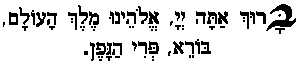
Baruch Atah Adonai Eloheinu Melech ha-olam,
borei p'ri ha-gafen.

(All drink the second cup of wine.)
Back to Introduction |
On to Part III
Last update: March 3, 1999
Created and maintained by Bob Parnes
Please send your comments to bparnes@umich.edu
|